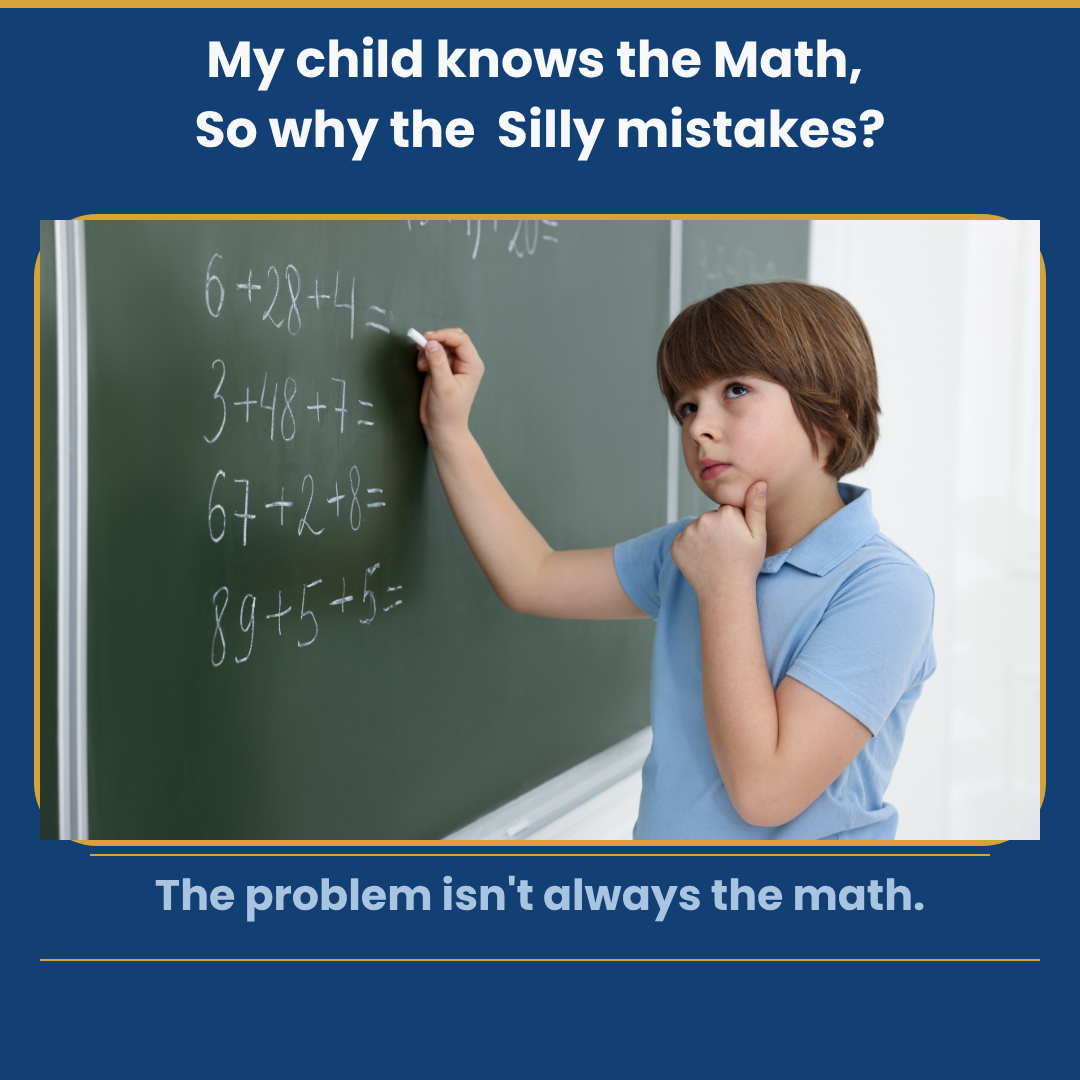
“Reema Ma’am, my child knows the answer. But still, they lose marks because of silly mistakes.”
I have heard this from many parents.
A child solves a difficult question correctly but loses a mark on a simple calculation. They add instead of subtracting. They miss a word in the question. They copy a number incorrectly. Or they choose the wrong option even though the correct working is right there on the page.
It is easy to call these careless mistakes. But are children really being careless?
Not always!!
Very often, what looks like carelessness is actually a habit that can be identified and improved. Following can be the reasons for the so called careless mistakes.
1. They Are Solving Too Fast
Some children believe that being good at Math means being fast. The moment they see a familiar question, they start solving it—sometimes before they have finished reading it. Words such as not, difference, remaining, at least, or altogether can completely change what a question is asking.
A child may know exactly how to solve the problem and still get it wrong simply because they answered a slightly different question.
Encourage your child to pause for a few seconds before solving and ask: “What exactly do I need to find?”. That small habit can prevent many errors.
2. They Are Not Reading the Entire Question
This is especially common in word problems and Olympiad-style questions. Children often spot familiar numbers or keywords and immediately decide which operation to use. But good problem-solving is not about finding a keyword. It is about understanding the situation. A question may contain extra information. It may have more than one step. Or the obvious operation may not be the correct one.
Before solving, ask your child to identify:
-
- What information is given?
-
- Is all the information useful?
This takes only a few seconds, but it can change the way a child approaches a problem.
3. They Are Trying to Do Too Much Mentally
Mental Math is an important skill. But sometimes children try to hold too many steps in their head because they want to solve quickly. They may understand the entire method but forget one number halfway through. For a multi-step problem, writing one or two clear steps is often faster than solving everything mentally and then starting again after a mistake. The aim is not to write more. It is to write just enough to keep the thinking clear.
4. They Do Not Check Whether the Answer Makes Sense
Many children finish a calculation and immediately move to the next question.
They do not ask: Does my answer make sense?
Suppose a question asks for the number of students in a class and the answer is 2,450.The calculation may be complete, but the answer should immediately feel suspicious. Children need to develop the habit of looking at an answer before accepting it. A quick estimate or a simple sense-check can catch many mistakes.
5. They Keep Making the Same Type of Mistake
This is something parents can watch for.
Does your child often:
-
- copy numbers incorrectly?
-
- miss one part of a question?
-
- rush through easy questions?
-
- calculate correctly but mark the wrong option?
If the same type of error happens repeatedly, it is no longer just a random careless mistake.
It is a pattern.
And once you identify the pattern, it becomes much easier to work on it.Instead of saying, “Be more careful,” give the child one specific thing to check.
For example: “Before moving to the next question, check that you marked the same option you calculated.”
That is much more useful than a general reminder to concentrate.
So, How Can We Help as Parents?
After a test or practice session, do not look only at how many answers were wrong.
Look at why they were wrong. Was it a concept problem? A reading mistake? A calculation error? A rushed answer? A missed step? A wrong option marked?
Different mistakes need different solutions.
A child who does not understand fractions needs more concept practice.
A child who understands fractions but repeatedly copies numbers incorrectly does not.
Both children may lose the same number of marks, but they need completely different kinds of help.
Final Thought
The next time your child makes a “careless mistake,” try not to stop at: “You knew this. You should have been more careful.”
Instead, ask: “What exactly happened here?”
That question can tell you much more. Because fewer mistakes do not come from repeatedly telling children to be careful. They come from helping children recognise where their own mistakes happen—and what they can do differently next time.
At Simplified Mathematics, we believe that good Math practice is not only about getting more questions right. It is also about helping children understand how they think, where they get stuck, and how they can improve.
Explore more Maths Olympiad practice at Simplified Mathematics.